


The world has been talking about K-Wave for years, from chart-topping hits to binge-worthy dramas and fashion moments that flood our feeds. But in Indonesia, the story goes way beyond fandom. When global culture meets one of the world’s most diverse, expressive, and digitally fluent generations, something different happens. Behind trending hashtags, viral edits, and everyday references lies a deeper shift: Indonesian Gen MZ isn’t just consuming K-Wave, they're reshaping it, remixing it, and making it feel unmistakably local. From the way they speak and dress, to what they eat, watch, and share, K-Wave has aevolved into something far more personal than pop culture.
Cheil Indonesia’s latest Kwave report takes you inside this transformation. Directionally informed by a quantitative online survey of 100 Gen Z and Young Millennial respondents aged 18–35, comprising 67 female and 33 male participants from several major cities in Indonesia, the study was conducted in December 2025. The findings explore how Korean cultural influence has moved beyond entertainment and quietly blended into everyday lifestyle. Spoiler alert: Indonesia isn’t just riding the K-Wave. It's shaping its own expression.
From “Just Watching” to Living It: K-Wave Goes Fully Mainstream in Indonesia
K-Wave is no longer something Indonesian Gen MZ simply watches on screen — it’s something they live with every day. Cheil Indonesia’s K-Wave study shows that 90% of Gen MZ express positive interest toward K-Culture, while 87% already see it as a long-term lifestyle, not a passing hype. The journey often starts with K-Pop (79%) or K-Dramas and K-Films (72%), before naturally expanding into K-Food (66%), K-Beauty (44%), and K-Fashion (39%). K-Wave doesn’t arrive all at once — it pulls Gen MZ in, layer by layer, until it becomes part of daily life.
And it doesn’t stop at interest. This connection shows up in real behavior, from what Gen MZ chooses to watch and listen to, to how they shape their daily routines and preferences. K-Wave has moved beyond screens into lifestyle decisions, influencing how they express themselves, what they engage with, and even how they evaluate brands. For many, Korean cultural influence isn’t just something to enjoy; it becomes part of how they live, choose, and connect with the world around them.
From Playlists to Plates: How K-Wave Slips into Everyday Life
For Indonesian Gen MZ, K-Wave doesn’t live in silos, it moves. It often starts with music, where K-Pop jumps out of playlists and into real life. In fact, 78 out of 100 respondents experience K-Wave through music and dance, often expressed through K-Pop cover communities, fan-made performances, random play dances in public spaces, and organized competitions that turn fandom into participation.
From there, the influence travels to screens, style, and habits. 67% feel K-Culture’s impact through dramas and films, inspiring local adaptations and new ways of telling Indonesian stories. Fashion and beauty follow naturally — K-inspired looks are worn daily, reworked through local taste, and embraced as self-expression rather than imitation. Even food becomes part of the mix, with 76 out of 100 respondents saying K-Food shapes their daily eating habits, as formats like mukbang are reimagined with Indonesian flavors and humor.
K-Wave is everywhere in Gen MZ’s daily life but it doesn’t stay foreign for long. The real shift happens when global culture gets remixed, localized, and made personal. For Indonesian Gen MZ, K-Wave doesn’t arrive as a finished product. It starts with admiration, moves into personalization, and lands as fusion, adapted to local tastes, habits, and humor until it feels homegrown. This is how global inspiration becomes something proudly personal and unmistakably Indonesian.
From the team behind the study, Rabiatul Aini Harahap, Strategic Planning at Cheil Indonesia, sees K-Wave as more than a pop culture phenomenon, it’s a window into how Gen MZ shapes identity today. “As a K-Pop enthusiast, this project felt very personal to me. But what stood out most wasn’t the idols or the music, it was how Indonesian Gen MZ actively filtered and adapted K-Wave to fit their own lives. They don’t consume it passively; they select, reinterpret, and make it relevant to their everyday reality,” said Rabiatul. According to her, K-Wave becomes a comfortable entry point for Gen MZ to explore style, self-expression, and community, without losing their local identity.
Fusion Isn’t a Concept — It’s Daily Behavior
Fusion happens casually, often without thinking. In fact, 85% of Gen MZ have tried mixing Korean and local culture at least once, and 53% repeat it as part of daily habits. The safest entry points? Food, language, and style — from kimchi with sambal, everyday Korea slang, to OOTDs inspired by K-style but worn the Indonesian way. They’re not becoming Korean, they’re K-ifying their own lives. Unlike fast-burning global trends, K-Wave keeps evolving in Indonesia because it fits how Gen MZ lives today. It’s emotionally relatable, always present on digital platforms, easy to localize, and powered by communities that keep it fresh. The result? K-Wave doesn’t feel distant — it feels accessible, flexible, and alive.
Cheil Indonesia’s findings show that fusion is not an instant result, but a gradual journey. It begins with admiration, moves into personalization, and eventually becomes fusion, where Korean and Indonesian elements blend naturally. At this stage, K-Wave no longer feels foreign. It shows up in everyday choices, from fashion and food to language, habits, and the content Gen MZ consumes and creates. This is why successful fusion never feels forced. It’s not about how many Korean elements are added, but how seamlessly they fit into local behaviors, preferences, and cultural values. When done right, fusion feels lived-in, relatable, and genuinely meaningful to Indonesian Gen MZ.
More Than Entertainment: K-Wave as Emotional Support
K-Wave has also become a quiet companion in daily life. 79% say it inspires them, 51% turn to it as an emotional escape, and 37% see it as a way to project their ideal selves. As Yasmine, a 23-year-old student, put it — “Korean content is more than just fun. It’s my escape. When I’m stressed or tired, it comforts me and helps me forget the pressure, even for a moment,” she confessed with a laugh. From music to dramas, K-Wave helps Gen MZ process emotions, imagine possibilities, and feel understood far beyond just being entertained.
So, What Makes K-Wave Stick in Indonesia?
Because it connects, not just trends.
K-Wave resonates through universal themes, from ambition and friendship to identity and self-expression — making it emotionally close and culturally meaningful for Indonesian Gen MZ.Because it’s always on.
Living where Gen MZ lives, K-Wave thrives on social platforms where content is fresh, shareable, and constantly part of everyday scrolling — keeping it relevant without feeling forced.Because it blends into daily life.
Rather than standing out as something foreign, K-Wave naturally integrates into Indonesian routines, amplified by local influencers, communities, and cultural moments that make it feel lived-in.Because communities keep it alive.
More than fandom, K-Wave is sustained by communities that continuously remix, regenerate, and renew its relevance — ensuring it keeps evolving, not expiring.
This cultural exchange isn’t one-directional. As Indonesians remix K-Wave, Korean audiences are also picking up Indonesian trends, especially on TikTok. From fashion moments to viral formats, local Indonesian creativity is now part of the global conversation. K-Wave didn’t just land in Indonesia, it learned from it.
Fusion, Done Right: When Brands Blend In (Not Force Their Way In)
Gen MZ doesn’t want brands to “jump on” K-Wave, they want brands to blend into how fusion already happens in real life. In fact, 95% are open to brands that integrate K-Culture meaningfully, however 98% prefer fusion that starts from local culture, not imported concepts. For them, Korean elements work best as an ingredient, not the main dish.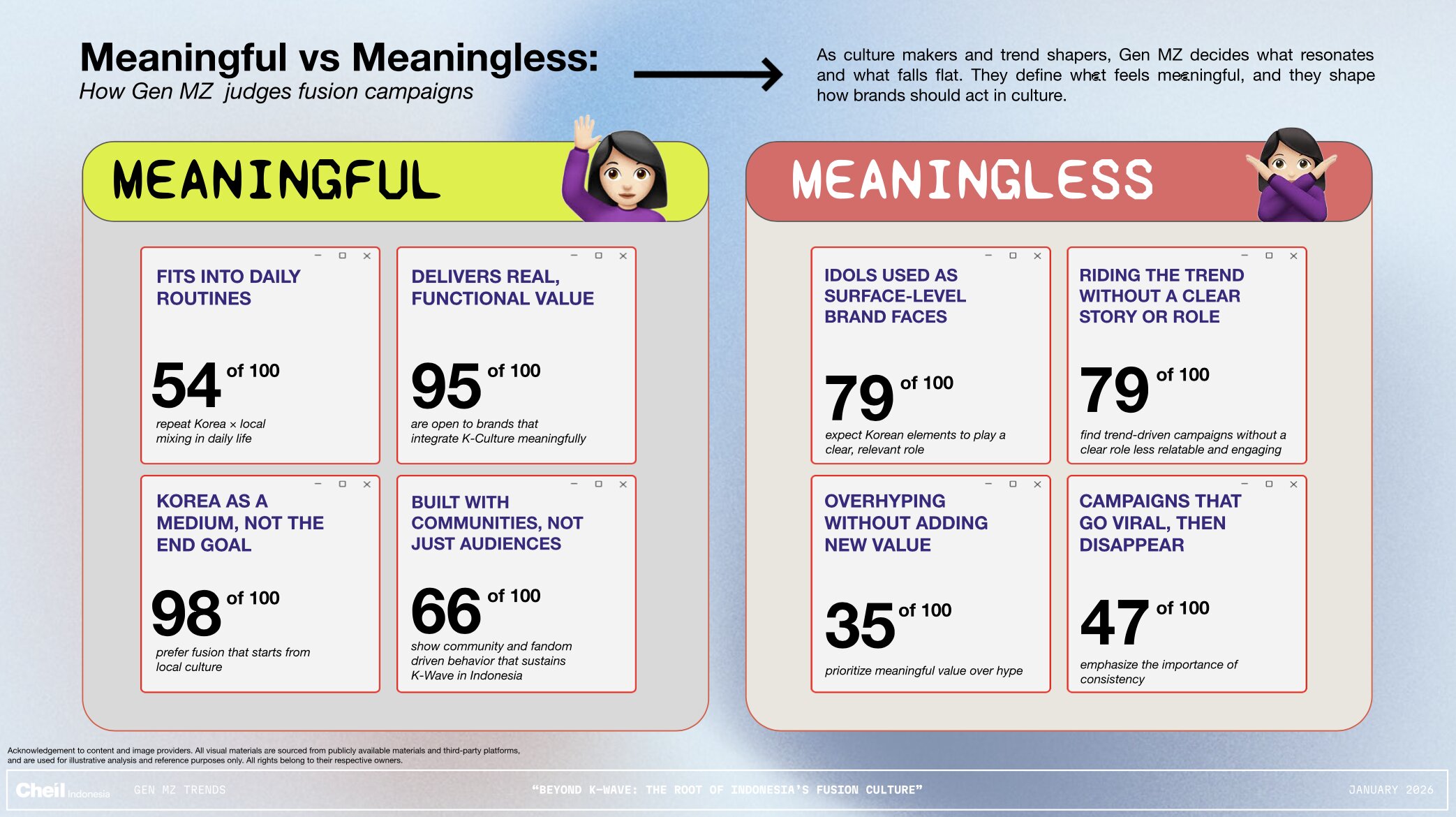
Fusion isn’t about adding Korean elements, it’s about understanding how Indonesian Gen MZ already remix culture, then showing up in ways that feel natural, respectful, and genuinely useful.
From Trend to Truth: F.U.S.I.O.N as Indonesia’s Cultural Formula
F.U.S.I.O.N — What We’ve Learned
K-Wave’s strength in Indonesia doesn’t come from popularity alone, but from how seamlessly it fuses into real life. Indonesian Gen MZ doesn’t adopt culture — they adapt it. They Fuse global influences with local values, Use them in daily routines, Shape them through personal expression, Integrate them into communities, and ultimately Own them as part of who they are. This is why K-Wave in Indonesia doesn’t peak, it evolves.
F.U.S.I.O.N — What Comes Next
Based on this study, Cheil Indonesia sees fusion not as a creative tactic, but as a broader strategic role brands can play in culture. This shift reframes how brands show up — moving beyond trend amplification toward cultural participation. To stay relevant in the Fusion Culture era, brands need to build platforms that invite remixing, create ideas designed to live beyond launch moments, and anchor global inspirations in local truths. In a culture shaped by F.U.S.I.O.N, relevance isn’t claimed; it's built through consistency, contribution, and co-creation.
Dear brands, here’s the real takeaway…
K-Wave isn’t a shortcut and Gen MZ can tell. To stand out, brands need to move past trend-chasing and start building culture, not just borrowing it. The ones that win are those that blend in, not force it — creating spaces for Gen MZ to remix, personalize, and truly make things their own. Relevance today isn’t about riding what’s popular; it’s about showing up in ways that feel real, local, and lived-in. Brands that get this won’t just earn attention — they’ll earn participation, connection, and loyalty that last